



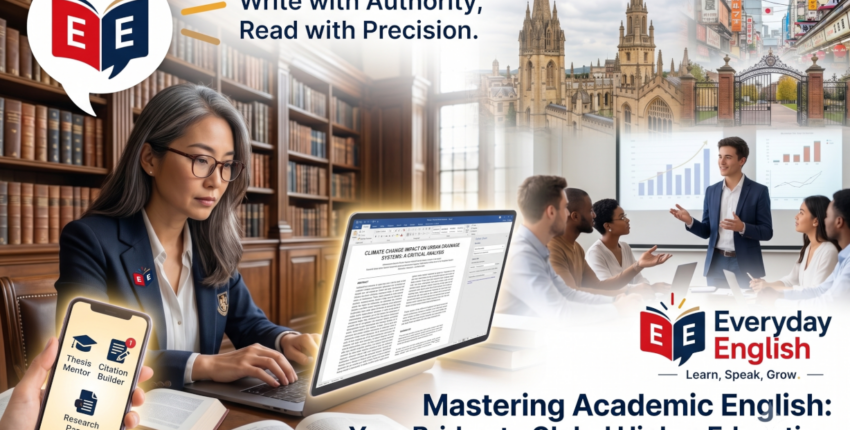
Master the Lecture Hall: Academic English Prepares You for University Success
Walking into a university lecture hall for the first time is exhilarating. But if you are an international student, that excitement can quickly mix with a wave of intimidation. The professor is speaking rapidly, using complex terminology, and referencing thick research papers. The student next to you is typing notes at lightning speed, and you realize the syllabus requires a 3,000-word critical essay by the end of the month.
This is where standard conversational English hits its limit. To thrive in higher education, you need a different toolkit. You need Academic English.
Academic English is the specialized language of research, critical thinking, and formal analysis. It isn’t about using big words just to sound smart; it is about mastering the structure, tone, and logic required to succeed in a global university environment.
Here is how dedicating time to Academic English preparation transforms your university experience from a struggle to a triumph.
1. Decoding the Lecture: Beyond Just Listening
Hearing a language is one thing; processing a complex, hour-long academic argument is another. Academic English preparation trains your brain to listen for structural cues during lectures.
-
Signposting: You will learn to recognize verbal markers that signal transitions, such as “consequently,” “on the other hand,” or “this brings us to the core evidence.”
-
Effective Note-Taking: Instead of trying to write down every single word, you will master strategies to capture core concepts, data, and overarching theories efficiently.
2. Writing with Authority and Objectivity
In daily life, we write the way we speak—using casual expressions, personal anecdotes, and contractions. In the academic world, your writing needs to be precise, objective, and backed by evidence.
An Academic English program teaches you how to structure formal literature reviews, research papers, and argumentative essays. You will learn how to build a bulletproof thesis statement, integrate data naturally, and—crucially—master the art of formal citation to avoid plagiarism.
3. Developing the Power of Critical Analysis
In many global universities, professors don’t just want you to memorize facts; they want you to question them. Academic English is deeply tied to critical thinking.
Through this program, you learn the vocabulary of debate and evaluation. You won’t just summarize what an author said; you will learn how to analyze their methodology, point out flaws in their logic, and present your own counter-arguments confidently in formal seminar discussions.
4. Surviving (and Thriving in) the Reading Load
The sheer volume of weekly reading in higher education can overwhelm even native speakers. Academic journals are dense and filled with discipline-specific jargon.
Preparation courses give you the speed-reading and comprehension strategies needed to handle massive text loads. You will learn how to skim for big ideas, scan for specific data, and read deeply only when a section is vital to your research.
Step Into University with Total Confidence
Your academic dreams shouldn’t be limited by a language barrier. At Everyday English, our Academic English program is specifically designed to simulate the real university experience. Through academic writing workshops, mock seminar debates, and advanced reading analysis, we ensure you cross the stage at graduation with pride.
Learn, Speak, Grow. Your higher education journey starts with the right foundation.
What specific aspect of university life—whether it’s writing long research papers, participating in class debates, or understanding fast-paced lectures—feels like the biggest hurdle right now?